17.3%
Shorter equipment service life
Average reduction estimated by 12 survey respondents for equipment exposed to deicers; not years gained through Krown treatment.
Normalized service-life baseline = 100%Table 4, printed p. 32 (PDF p. 34) [1]
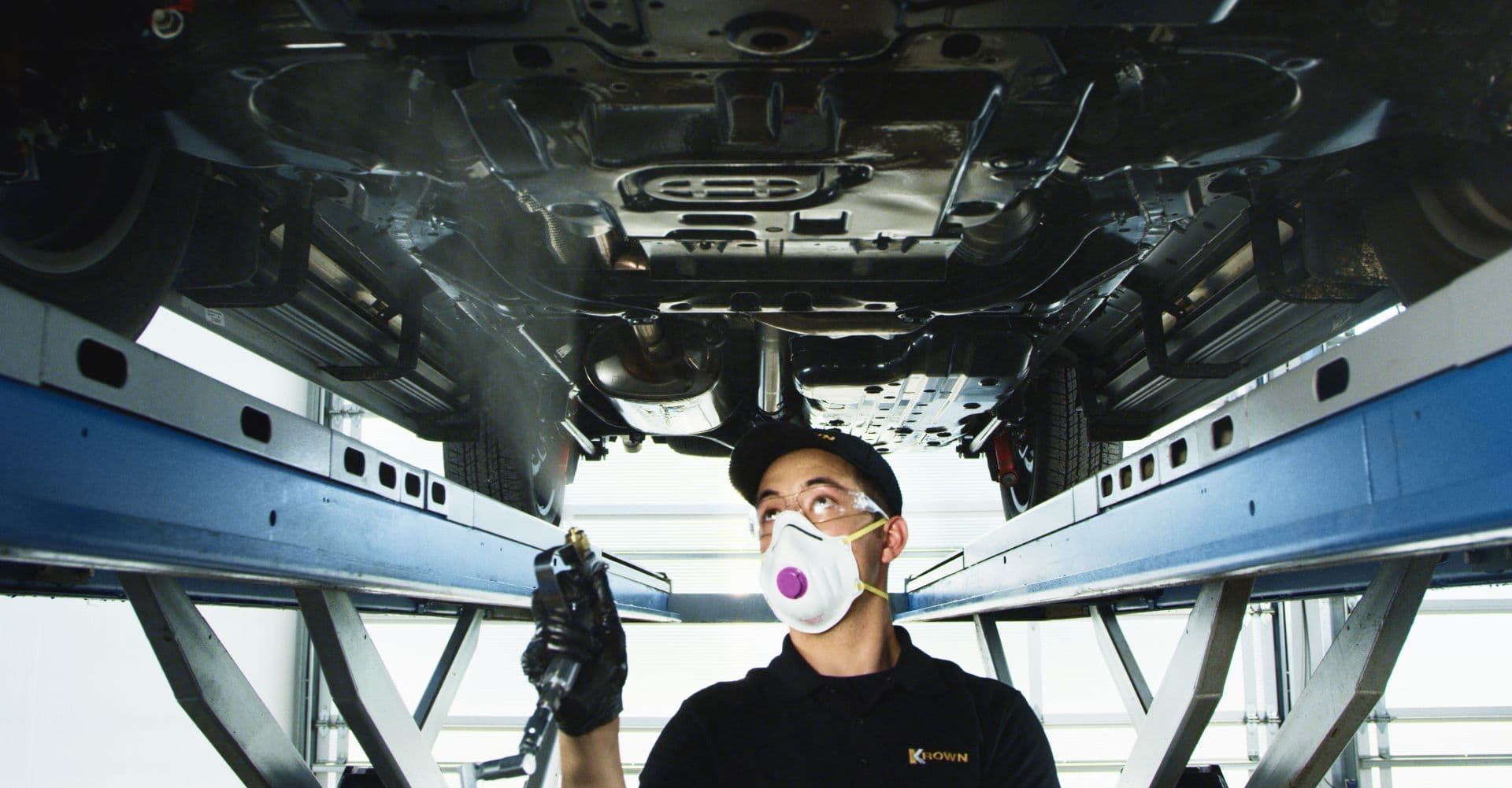
The researchers identified Krown as the best-performing spray-on inhibitor among those tested in their preliminary carbon-steel / magnesium-chloride investigation.
That is a test-specific result, not a ranking of every product or a guarantee for complete vehicles.
“Under the investigated conditions, the best-performing coating (Rust Bullet), spray-on corrosion inhibitor (Krown) and salt removers (HoldTight and ChlorRid) were identified”
Shi et al. (2013), WA-RD 796.1 · Excerpt, printed p. 89 · Read the original conclusion [1]
The report also examines historical fleet costs and maintenance strategies. These figures are separate from the Krown laboratory results and are not Krown savings guarantees.
17.3%
Average reduction estimated by 12 survey respondents for equipment exposed to deicers; not years gained through Krown treatment.
Normalized service-life baseline = 100%Table 4, printed p. 32 (PDF p. 34) [1]20%
WSDOT scenario assuming 75% more investment in equipment corrosion management and a shift toward proactive maintenance.
Modeled program estimate; not measured Krown ROICost-benefit analysis, printed p. 87 (PDF p. 89) [1]4.3–9.3%
Corrosion-related repair shares: 4.3% for the WSDOT fleet and 9.3% for its snowplows. The denominator excludes preventive maintenance.
Historical fleet records; not treatment savingsConclusions, printed p. 90 (PDF p. 92) [1]Explore what a Krown Maintenance Program could mean for your fleet. This example shows possible savings after the additional cost of the program.
Illustrative scenario · CAD · annual net savings
A modest reduction in repairs could free up part of your maintenance budget.
The same scenario, applied to each unit in a 100-piece fleet.
Calculation: $5,000 × 14–20% − $500 = $200–$500 net per unit, per year.
Break even at 10% in this example. Avoiding $500 in repairs would cover the assumed program cost. Potential downtime and equipment-life benefits are not included.
The 2013 WSDOT report (section 3.6, pp. 84–87) models a 20–25% reduction in overall deicer-related corrosion costs for a broader corrosion-management strategy. This example uses a more cautious assumption of a 14–20% reduction in repair bills; that rate was not measured in the study. The study did not measure these dollar savings for a Krown program. Laboratory corrosion-rate reductions do not translate directly into equivalent reductions in repair bills.
The $5,000 and $500 inputs are illustrative Canadian-dollar amounts, not study observations or a Krown price quote. Actual program cost must include additional product, application labour, washing and equipment time at the agreed maintenance frequency. Results depend on condition, use and exposure. Savings are not guaranteed.
Read the WSDOT report · section 3.6Illustrative estimate, not a measured Krown outcome. Actual costs and savings will vary.
Make prevention part of the routine.
Use the research to start a practical conversation about your vehicle, its exposure and an appropriate maintenance plan.
The report discusses washing, protective products, material choices and maintenance as complementary strategies. No single product replaces a complete corrosion-management program. Implementation recommendations, printed pp. 91–93 [1]
The cyclic study used eight 24-hour cycles per deicer exposure test and reapplied Krown T40 each cycle. Ask your Krown team about a service schedule suited to your vehicle; the laboratory regimen is not a consumer service instruction. Cyclic exposure methods, printed pp. 22–26 [1]
The report studied sodium- and magnesium-chloride environments. Calcium chloride was outside its stated scope. Vehicle design, use, weather and application practices can affect real-world outcomes. Study scope, printed p. 17 [1]
A closer look at the testing, its findings and what they mean for corrosion prevention.
Video explainer coming soon. In the meantime, explore the findings and original sources below.
One vehicle or a whole fleet. Let’s talk about making Krown part of your maintenance plan.
This research is not an official WSDOT endorsement or recommendation of Krown. The report states that its contents reflect the authors’ views, do not necessarily reflect WSDOT or FHWA views or policies, and do not constitute a standard, specification or regulation (printed p. 3).
No. The report describes repeated Krown T40 application during accelerated laboratory exposure cycles on metal specimens and extrapolates approximately 19 applications per year. It does not establish at least 99% corrosion-rate reduction from a single annual rustproofing service, nor 99% fewer repairs or financial savings.
No. Krown performed strongly under specific conditions, but the results vary by material, test and metric. The report identifies other products as strong performers in their categories. For cyclic carbon-steel panels it describes lower average corrosion with Krown than with Rust Oleum, but somewhat more severe localized attack on the Krown-protected panel (printed p. 67).
No. The 17.3% service-life estimate comes from survey responses. The 20% cost reduction is an assumed WSDOT maintenance-program scenario requiring 75% more investment. The 4.3% and 9.3% figures describe historical corrosion-repair shares. None measures Krown’s effect on a fleet’s costs.
This is the underlying 2013 WSDOT technical report discussed in the Alaska report’s literature review. The related Li et al. journal article reports work by the same research team. These should not be presented as multiple independent replications of the same finding.
Original research, direct links and page-specific references.
This is a Krown marketing summary of historical research. Laboratory performance and modeled maintenance savings do not guarantee results for your vehicle or fleet.
Shi, X., Li, Y., Jungwirth, S., Fang, Y., Seeley, N. & Jackson, E. Identification and Laboratory Assessment of Best Practices to Protect DOT Equipment from the Corrosive Effect of Chemical Deicers. Western Transportation Institute, Montana State University. Prepared for Washington State DOT. WA-RD 796.1, March 2013.
Printed pages / PDF pages: disclaimer 3 / 5; methods 22–26 / 24–28; screening and two-week tests 36–41 / 38–43; panel comparison 65–67 / 67–69; cost scenario 87 / 89; conclusions 89–90 / 91–92.
The U.S. National Transportation Library preserves the same WSDOT report and its downloadable PDF. This is an alternate access point, not a second study.
Li, Y., Fang, Y., Seeley, N., Jungwirth, S., Jackson, E. & Shi, X. Corrosion by Chloride Deicers on Highway Maintenance Equipment: Renewed Perspective and Laboratory Investigation. Transportation Research Record, 2361(1), 106–113. DOI: 10.3141/2361-13. Related work from the same research team, not an independent replication. Publisher access to the full article may vary.